One of the first questions businesses ask us about Zoho CRM is: how much does it cost to implement?
The software itself is relatively easy to price. Implementation is harder because two businesses using exactly the same Zoho CRM edition can require completely different systems.
A small company replacing a spreadsheet with a straightforward sales pipeline might need little more than some configuration and a data import. Another might need several sales processes, years of historical data, automation, integrations and custom development.
Both are "Zoho CRM implementations", but their costs can be very different.
So, what should you realistically budget in the UK in 2026?
How much does Zoho CRM cost?
How much does Zoho CRM cost?
There are two separate costs to consider: the Zoho CRM licences and the implementation.
At the time of writing, Zoho CRM's UK pricing when billed annually is:
| Edition | Price per user/month |
|---|---|
| Free | £0 |
| Standard | £12 |
| Professional | £18 |
| Enterprise | £35 |
| Ultimate | £42 |
Prices exclude VAT and monthly billing is available at a higher rate. As pricing and packaging can change, we'd always recommend checking Zoho's current pricing before making a purchasing decision.
The edition you need depends less on the size of your business and more on what you need CRM to do. Higher editions introduce greater customisation, automation, process management and system limits.
It's also worth looking beyond standalone CRM licensing. If your business expects to use several Zoho applications, Zoho One can be worth considering as it includes CRM alongside a much wider suite of business applications.
Importantly, paying for the licence gives you access to the software. Implementation is the work required to turn that software into a CRM that works around your business.
How much does Zoho CRM implementation cost?
How much does Zoho CRM implementation cost?
As a broad guide for UK businesses:
| Implementation | Typical cost |
|---|---|
| Basic setup | £500 - £1,500 |
| Typical SME implementation | £2,000 - £6,000 |
| More complex implementation | £6,000 - £15,000 |
| Large/custom implementation | £15,000+ |
These aren't fixed Ostratto packages. They're indicative ranges to help demonstrate the difference in scale between CRM projects.
A basic setup might involve configuring the standard CRM modules, creating a sales pipeline, adding some custom fields and importing a clean spreadsheet.
A typical SME implementation is more likely to include discovery, multiple processes, automation, permissions, reporting, data migration and training.
A more complex implementation might introduce custom modules, Blueprint processes, custom functions, integrations, significant data migration or several teams with different requirements.
At the upper end, CRM can become part of a much wider operational system involving applications such as Zoho Books, Desk, Analytics, Forms, Sign or Projects.
What are you actually paying for?
What are you actually paying for?
Professional CRM implementation isn't simply paying somebody to create fields in Zoho.
Depending on the project, you're paying for discovery to understand how the business operates, CRM architecture to determine how those processes should be represented, and then the actual configuration of modules, fields, layouts, pipelines, permissions and reporting.
There may also be data migration, including cleaning and restructuring existing information before it can be imported properly. Automation and integrations need to be designed, built and tested. Users need training, and somebody needs to manage the transition from the old way of working to the new system.
The implementation might therefore include:
- Discovery and process mapping
- CRM architecture and configuration
- Data cleaning and migration
- Workflow automation
- Integrations and custom development
- Testing
- User training
- Go-live
- Post-launch support
Some projects need very little of this. Others need all of it.
That's where most of the difference in price comes from.

Discover

Implement
Once the requirements are clear, we design and build your Zoho CRM around them. This can include CRM architecture, configuration, data migration, automation, integrations and reporting, followed by thorough testing. Throughout the implementation we work with your team to validate the solution and make sure what we're building works in practice, not just on paper.

Operate
The £1,000 Zoho CRM implementation versus the £20,000 implementation
The £1,000 Zoho CRM implementation versus the £20,000 implementation
This is where comparing CRM implementation quotes based on price alone becomes difficult. Two suppliers may both describe their service as a "Zoho CRM implementation", while the amount of work included in each proposal can be substantially different.
At the lower end, a £1,000 implementation might cover the configuration of a sales pipeline, some custom fields, an import of existing customer data and a training session. For a business with straightforward requirements, that may be everything it needs and could represent perfectly good value.
A £20,000 implementation is likely to represent a very different project. It might include detailed process discovery, CRM architecture, multiple modules and pipelines, complex data migration, integrations with other systems, custom functions, extensive automation, management reporting, testing, training and support during the transition to the new system.
The difference in price therefore isn't necessarily an indication that one supplier is expensive and another is cheap. In many cases, the underlying scopes simply aren't comparable. When reviewing proposals, it is more useful to understand what has been included, what has been excluded and how closely the proposed solution reflects what the business actually needs.
An inexpensive implementation can become costly if important requirements are discovered later and have to be added retrospectively. Equally, there is little benefit in paying for a sophisticated implementation if the business only needs a well-configured sales pipeline and a clean customer database. A good proposal should make it clear why each element of the project is required and how it contributes to the finished CRM.
What makes a Zoho CRM implementation more expensive?
What makes a Zoho CRM implementation more expensive?
The number of users is often less important than the complexity of the business processes being implemented. A company with 50 CRM users following one straightforward sales process could require less implementation work than a six-person company with several workflows, integrations and different types of customer.
Costs tend to increase where there are multiple processes or teams to accommodate, significant amounts of existing data to migrate, integrations with other systems, custom development, more sophisticated automation or complex reporting and permission requirements.
Data migration can be a particularly significant factor. Importing a clean spreadsheet containing 500 customers is relatively straightforward. Migrating ten years of information from an existing CRM may involve duplicates, inconsistent formatting, historic activities and relationships between different records. In those circumstances, preparing and validating the data can represent a meaningful part of the overall implementation.
The same applies to integrations and automation. Connecting two systems using an existing native integration may require relatively little work, whereas a bespoke API integration or custom function needs to be designed, developed, tested and maintained. These differences are why implementation costs are generally better estimated from the requirements than from the number of CRM users.
Can you implement Zoho CRM yourself?
Can you implement Zoho CRM yourself?
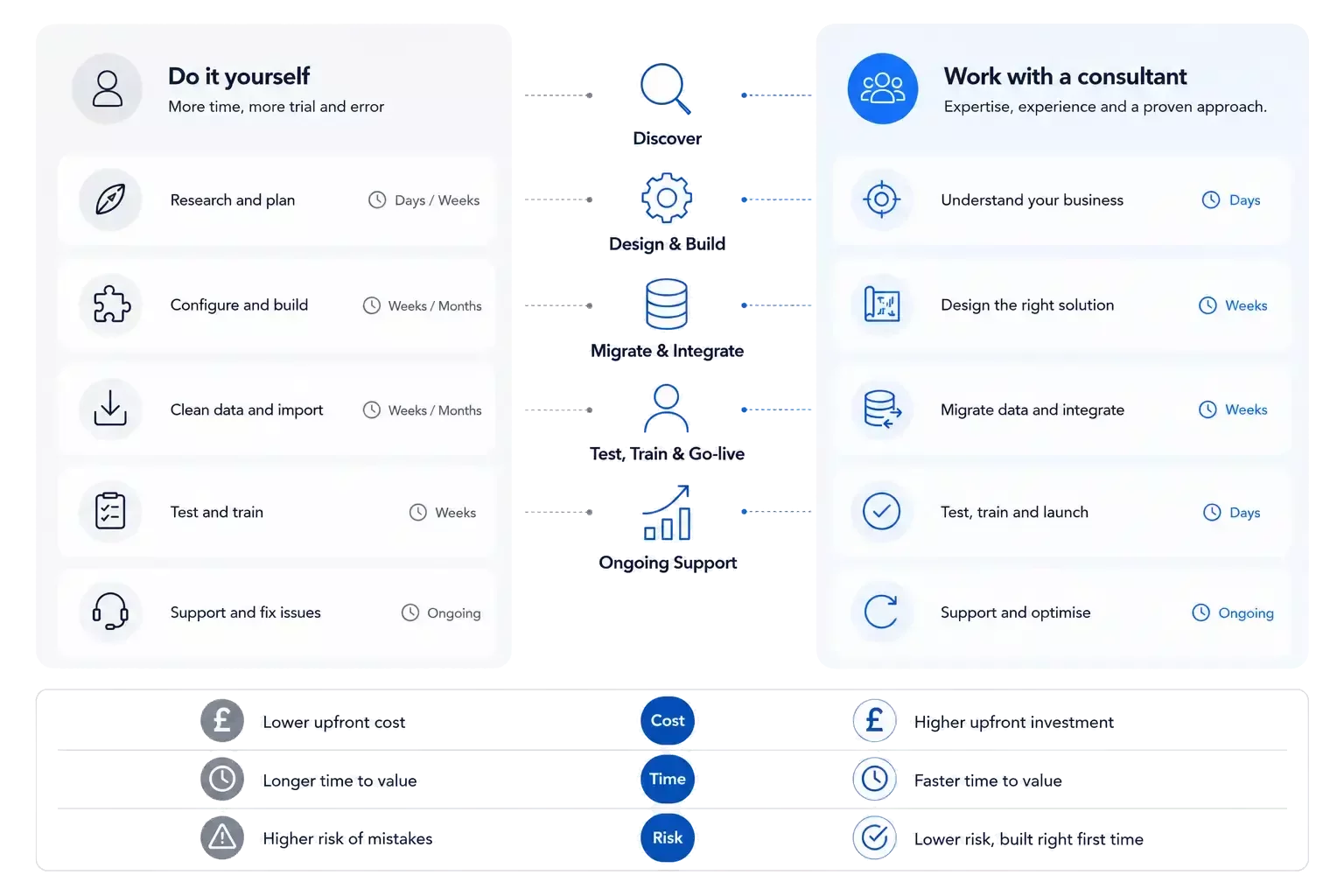
Yes. For businesses with relatively simple requirements, implementing Zoho CRM internally can be a perfectly sensible option.
A small team moving from spreadsheets to a straightforward sales pipeline may only need to configure the standard modules, add some fields, create its pipeline and import existing customer data. If somebody within the business has the time and interest to learn Zoho, paying a consultant to do all of that may not provide enough additional value to justify the cost.
Consultancy becomes more useful as the consequences of design decisions increase. If several teams will depend on the CRM, existing data needs to be migrated carefully, other systems need to be connected or important business processes are going to be automated, experience with the platform can save a considerable amount of trial and error.
There is also an internal cost to a DIY implementation that is easy to overlook. If a director or senior employee spends 60 hours learning the platform, preparing data, building workflows and resolving problems, the implementation hasn't really been free. The cost has simply been absorbed by the business rather than appearing on a supplier invoice.
The decision therefore isn't simply between paying for consultancy and implementing Zoho CRM for free. It is a question of whether the time saved, risks avoided and quality of the resulting system justify bringing in specialist support.
So, what should you budget?
For a small business with straightforward requirements, £1,000 to £3,000 plus licences is a sensible starting point. An established SME looking for a CRM designed properly around its processes is more likely to fall somewhere around £3,000 to £8,000, while projects involving substantial data migration, integrations, custom development or several business processes can reasonably reach £8,000 to £15,000 or more.
These figures should be treated as indicative rather than as fixed packages. The most reliable way to establish an implementation budget is to define what the CRM needs to achieve, understand the condition of the existing data and identify which systems and processes need to be connected or automated.
That process may reveal that a sophisticated implementation is justified, but it may equally show that the business only needs a well-configured pipeline, a sensible data structure and a clean import of its existing customer information. The objective should be to build the CRM the business needs rather than making the implementation more complicated than necessary.
At Ostratto, we scope Zoho CRM projects around those requirements rather than trying to fit every business into the same implementation package. If you're considering Zoho CRM, we can help you understand what would actually need to be implemented and provide a scope based on that, before you commit to a larger project.
Contact
Get in touch with the team to discuss how we support your business with practical, people-first technology and long-term solutions.
About
Learn who we are, what we stand for, and how Ostratto helps businesses make their work, less work through practical technology solutions.
Our Approach
Discover how we partner with you - focusing on strategy, simplicity and long-term value to deliver technology that truly supports your business.