
Every time someone asks ChatGPT a question, generates an image or uses AI to analyse a document, computers inside a data centre process the request.
Those computers generate heat. Keeping them cool can require water, while generating the electricity that powers them may use even more.
For one simple AI prompt, the amount can be tiny. Across billions of prompts and increasingly powerful data centres, the figures become much harder to ignore.
The short answer
The short answer
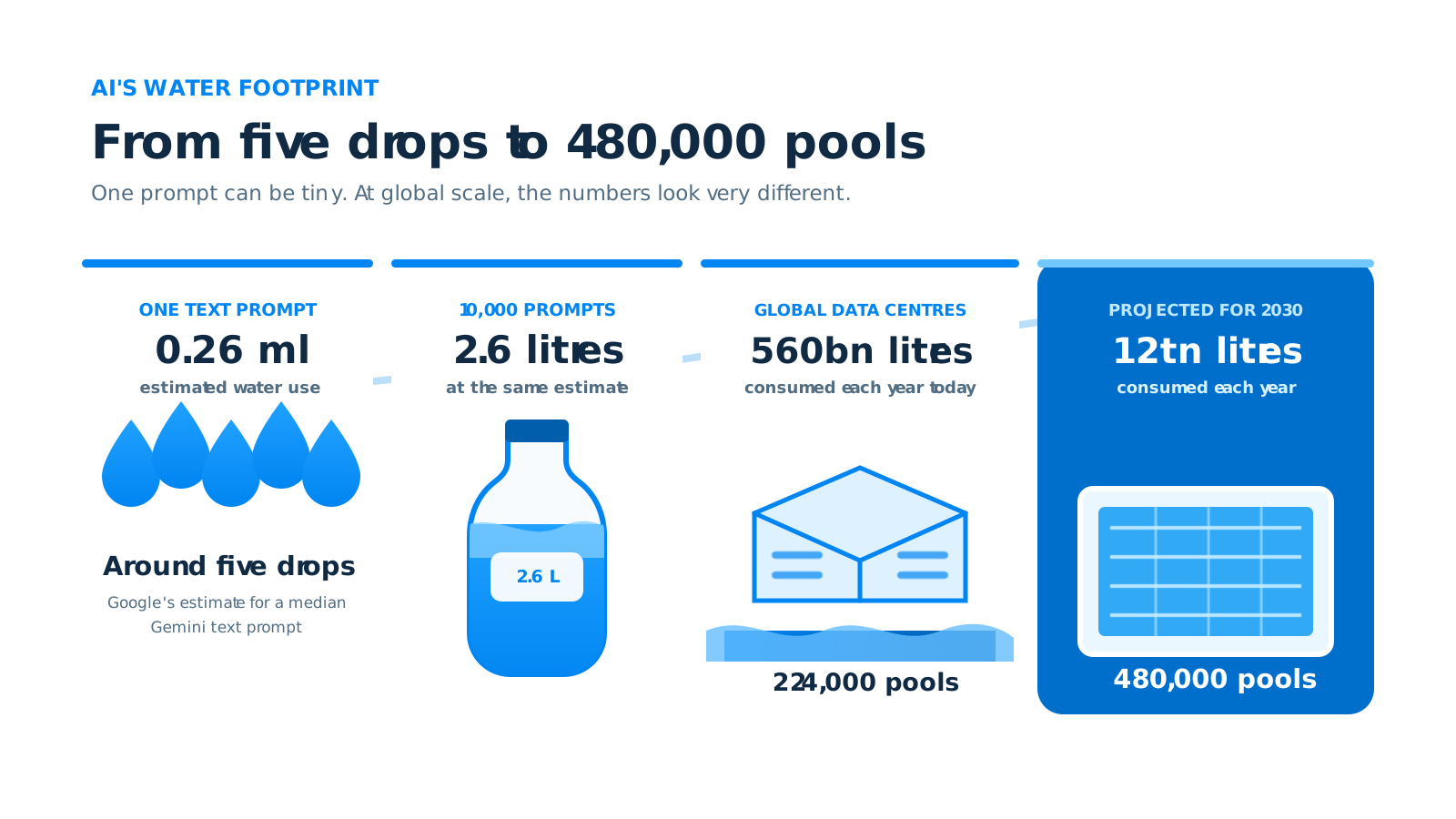
Google estimates that a median Gemini text prompt consumes approximately 0.26 millilitres of water, or around five drops.
At that rate, you could submit nearly 2,000 prompts before using the equivalent of a 500 ml bottle of water. Even 10,000 prompts would account for approximately 2.6 litres.
However, earlier academic research estimated that GPT-style models could consume around 500 ml for every 10 to 50 responses.
The estimates differ because they examine different models, locations, cooling systems and sources of water use. AI infrastructure has also become considerably more efficient.
The larger figures reveal the real scale:
- Global data centres consume more than 560 billion litres annually
- A large 100 MW data centre could consume around 2.5 billion litres per year
- Global data centre consumption could reach 1.2 trillion litres annually by 2030
- AI-related water withdrawal has been projected to reach 4.2 to 6.6 trillion litres in 2027
Not all data centre activity relates to AI, and water withdrawal is different from water permanently consumed. Nevertheless, AI is helping to drive the rapid expansion of this infrastructure.
Why does AI use water?
Why does AI use water?
AI’s water footprint comes from three main sources.
The first is data centre cooling. The processors used to run AI models generate substantial heat. Some data centres use evaporative cooling, where water absorbs the heat before evaporating. A UK report on water use in AI and data centres suggests that around 80% of the water used by these systems can be lost through evaporation.
The second is electricity generation. Many power stations use water for cooling and other processes, creating an indirect water footprint outside the data centre.
The third is chip manufacturing. Semiconductor factories use highly purified water to clean silicon wafers while producing the advanced processors on which AI depends.
Some data centres use air cooling, closed-loop systems or reclaimed wastewater, so the amount of drinking-quality water required varies significantly between facilities.
Not every AI request is equal
Not every AI request is equal
A short text question does not require the same computing power as generating a video, analysing hundreds of pages or asking an advanced model to work through a complex problem.
Water use can be affected by:
- The model selected
- The length of the input and response
- Whether extended reasoning is required
- The number and size of uploaded files
- Whether the system generates text, images, audio or video
- The efficiency of the processors
- The cooling system and local weather
- The source of electricity
The International Energy Agency reports that the energy needed for individual AI tasks has been falling rapidly. However, video generation, extended reasoning and autonomous agents can consume hundreds or thousands of times more energy than simple text generation.
AI is becoming more efficient, but it is also being used more frequently and for more demanding work.
What does a large data centre use?
What does a large data centre use?
A 100 MW hyperscale data centre could consume approximately 2.5 billion litres of water annually, depending on its design and location.
That is equivalent to:
- 1,000 Olympic swimming pools every year
- Nearly 6.9 million litres every day
- The average daily household use of around 50,000 people in England
Not every data centre uses this much. Facilities using air cooling or recycled water may use considerably less. Climate also makes a difference, with hotter locations generally requiring more cooling.
The figure still demonstrates the difference between one prompt and the infrastructure processing millions of them around the clock.
From 224,000 to 480,000 swimming pools
From 224,000 to 480,000 swimming pools
Data centres globally currently consume more than 560 billion litres of water each year.
That would fill approximately:
- 224,000 Olympic swimming pools per year
- More than 600 Olympic swimming pools every day
- The equivalent annual domestic water use of over 11 million people in England
Not all of this is caused by AI. Data centres also support websites, cloud storage, streaming services and business software.
However, AI is contributing to the construction of new data centres and the installation of more powerful computing equipment. By 2030, global data centre water consumption could reach 1.2 trillion litres annually, equivalent to approximately 480,000 Olympic swimming pools.
That is more than 1,300 swimming pools every day, or almost one every minute.
How much do technology companies use?
How much do technology companies use?
In 2022, Google’s data centres consumed approximately 19.5 billion litres of water, enough to fill around 7,800 Olympic swimming pools.
Microsoft reported global water consumption of approximately 6.4 billion litres during the same year, representing an increase of 34% from 2021. That equates to roughly 2,560 swimming pools.
These totals cover wider cloud and corporate operations rather than AI alone. They do, however, show why per-prompt efficiency only tells part of the story.
A company can reduce the water required for each AI response while increasing its total consumption because the number of users, services and data centres is growing faster.
Could AI withdraw trillions of litres?
Could AI withdraw trillions of litres?
Academic research has projected that global AI demand could be responsible for withdrawing between 4.2 and 6.6 trillion litres of water in 2027.
At the upper end, that is enough to fill approximately 2.6 million Olympic swimming pools.
This figure relates to water withdrawal, which is the amount taken from a water source. Some of that water may later be treated and returned. Water consumption refers to the portion that evaporates or is otherwise unavailable for immediate reuse.
The figure therefore does not mean that 6.6 trillion litres will disappear. However, withdrawing water can still affect local supplies, particularly if it is returned somewhere else, at a different temperature or after the period when it was most needed.
Why this matters in the UK
Why this matters in the UK
The average person in England uses 136.5 litres of water per day. For comparison, a bath uses around 80 litres, a standard ten-minute shower can use between 100 and 150 litres, and a washing-machine cycle typically uses around 50 litres.
England is forecast to face a daily water deficit of nearly five billion litres by 2050. That is equivalent to the current daily household use of more than 36 million people.
Several existing and proposed data centre clusters are in areas already considered seriously water stressed. Cooling demand may also be highest during hot weather, precisely when household, agricultural and environmental demand is under the greatest pressure.
Water use is therefore not just about the global total. Where and when it is consumed matters enormously.
Should businesses use AI less?
The answer is not necessarily to stop using AI. A useful prompt that saves several hours of work may be a reasonable use of resources.
The better question is whether AI is being used deliberately or added to processes without a clear benefit.
Businesses can make more responsible choices by selecting smaller models for straightforward tasks, limiting unnecessary image and video generation, avoiding repeated requests without a purpose and considering environmental transparency when choosing technology providers.
Responsibility should not sit entirely with individual users. Technology companies need to report water use more consistently, including how much drinking-quality water they consume, where it is used and which cooling technologies they deploy.
Water use is falling
AI models, processors and data centres are becoming more efficient. A simple prompt can now require less energy and cooling water than it once did, reducing the environmental impact of each individual task.
AI usage is rising
At the same time, more people and businesses are adopting AI for increasingly complex work. The growth in users, prompts, image generation and other demanding tasks can outweigh the savings achieved per interaction.
Five drops can still become a flood
It is misleading to suggest that every short AI conversation consumes an entire bottle of water. Recent provider data indicates that a straightforward text prompt can use only a fraction of a millilitre.
It would be equally misleading to use that figure to dismiss the industry’s wider impact.
Data centres already consume hundreds of billions of litres each year. That demand could reach 1.2 trillion litres by 2030 as AI use grows and applications become more demanding.
One useful prompt is unlikely to create a meaningful water problem. Billions of prompts and enormous data centres concentrated in water-stressed areas potentially can.
Contact
Get in touch with the team to discuss how we support your business with practical, people-first technology and long-term solutions.
About
Learn who we are, what we stand for, and how Ostratto helps businesses make their work, less work through practical technology solutions.
Our Approach
Discover how we partner with you - focusing on strategy, simplicity and long-term value to deliver technology that truly supports your business.