Loading the Elevenlabs Text to Speech AudioNative Player...
AI could allow society to produce more with less human labour. Whether that translates into more leisure, greater insecurity or a wider gap between rich and poor will depend on how income, ownership and public services change alongside it.
Imagine a business that can deliver the same service with half the human effort. Its owners could reduce prices, increase profits, serve more customers, improve pay or shorten the working week. They could also reduce the number of people they employ.
All of those outcomes begin with the same technological improvement. Their consequences for the people involved are very different.
That is the difficulty at the centre of the debate about AI and the future of work. We can imagine machines doing a growing share of economically valuable activity. It is much harder to explain how everyone will live comfortably if paid employment becomes less necessary.
For most households, work provides the money that buys access to housing, food, energy and everything else. A future in which society needs less labour would therefore require more than better technology. It could require a different relationship between work and the right to a decent standard of living.
There is no reliable date for that future, and no certainty that it will arrive in its most dramatic form. But exploring it helps explain the decisions already facing businesses and governments.
What the evidence tells us about jobs
What the evidence tells us about jobs
The claim that AI will eliminate most employment goes much further than the research can currently establish.
The International Labour Organization and NASK estimated in May 2025 that one in four jobs worldwide was in an occupation potentially exposed to generative AI. Their assessment said that changes to jobs were more likely than their complete replacement. Exposure measures the potential for technology to affect tasks; it does not count redundancies or predict how quickly employers will adopt it.
A job usually combines many activities. Producing a report, handling an unusual complaint, taking responsibility for a decision and understanding what a customer actually needs may sit within the same role. Automating one activity does not automatically remove the rest.
There is also evidence that AI can help people work more effectively. A study published in The Quarterly Journal of Economics in 2025 examined 5,172 customer-support agents and found that access to an AI assistant increased issues resolved per hour by 15% on average. Less experienced and lower-skilled workers gained more than their more experienced colleagues. That is evidence from a particular workplace, rather than a prediction for the whole economy.
These findings leave room for several outcomes. Employers might expand services with the same team, employ fewer people, or combine both approaches. Productivity improvements do not determine which choice they make.
Software capability also differs from economical, dependable deployment. Systems need to work with existing processes, handle mistakes and justify their operating costs. Extending automation into construction, maintenance or personal care introduces physical challenges that a more capable chatbot alone does not solve.
Why a richer economy might still leave households worse off
Why a richer economy might still leave households worse off
The most important distinction is between producing wealth and distributing purchasing power.
Suppose a fictional company earns £1 million a year and spends £600,000 on wages. Imagine that automation eventually allows it to maintain its output while reducing that wage bill to £300,000. Assume, purely for illustration, that the technology and its operation add £100,000 in annual costs.
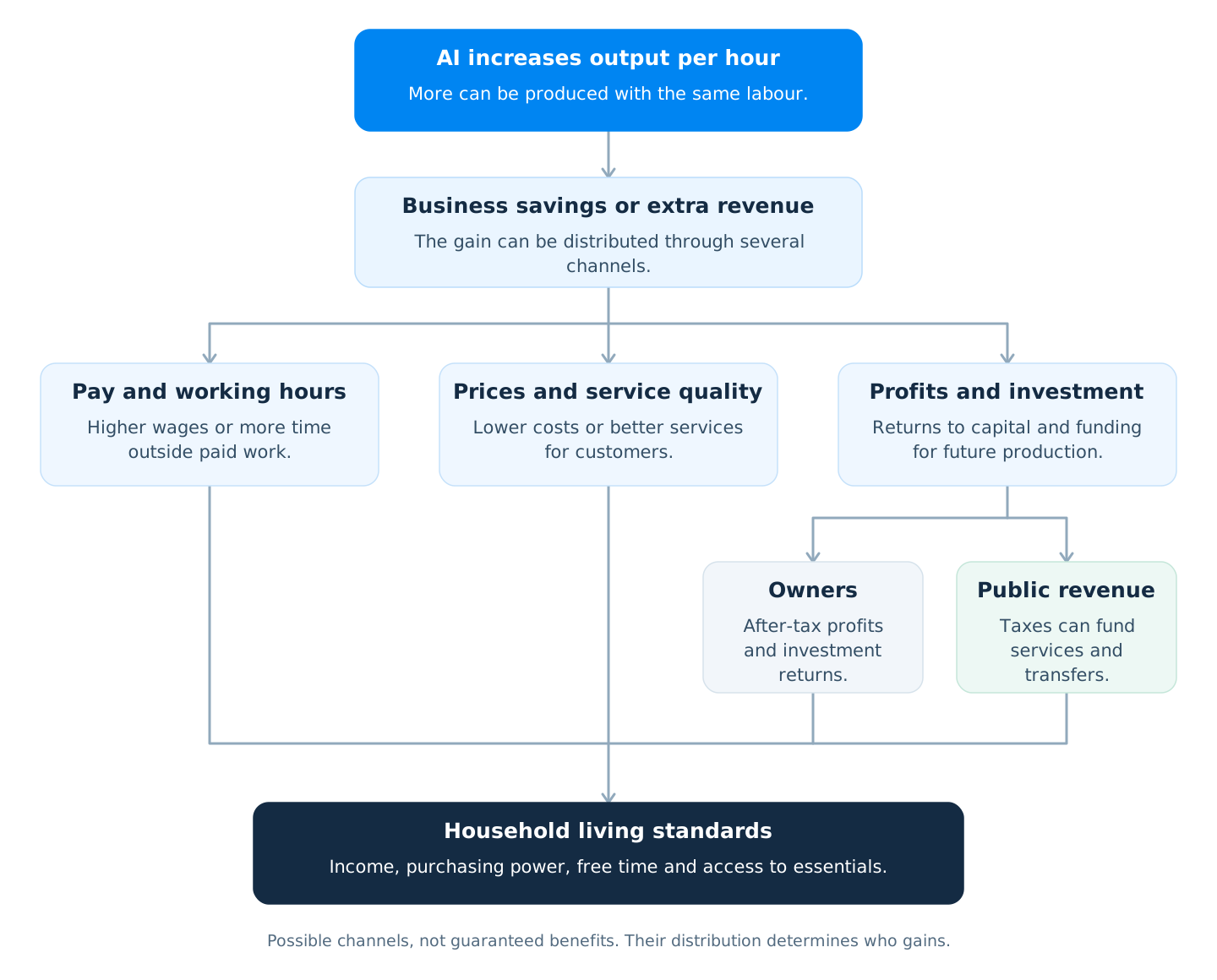
The business would then have £200,000 more available before any other changes. That money could support investment, lower prices, higher pay, shorter hours or greater returns to owners. The £300,000 reduction in wages could involve fewer staff, reduced hours or another change in employment.
This example is arithmetic, not a forecast. It shows why a more productive business does not automatically make every affected household better off.
Consumers might gain through lower prices while some workers lose their main source of income. Investors might benefit through higher profits while people without savings have little direct claim on those returns. The economy could grow overall while particular communities become poorer.
The IMF has identified both labour-income and ownership channels through which AI could increase inequality: some workers may benefit more than others, while higher returns to capital could favour people who already own assets. These are risks, rather than an unavoidable outcome.
The distribution of productivity gains can follow several routes:
Four possible futures for work
Four possible futures for work
There is no single economic theory that tells us precisely what comes next. Four broad scenarios help explain the range of possibilities.
| Possible future | How people earn a living | What could happen to inequality |
|---|---|---|
| AI assists most workers | Wages remain central, with jobs changing around AI | Gaps could narrow where tools spread expertise, or widen where access and bargaining power differ |
| Productivity supports shorter working weeks | People retain paid work but share some gains through more free time | Benefits depend on whether lower hours preserve adequate income and extend beyond privileged occupations |
| Ownership becomes more important than employment | Profits, assets and access to platforms matter more, while wages become less secure | Wealth could concentrate if displaced workers have little ownership or protection |
| Much less paid work is needed | Income comes from a mixture of remaining jobs, public transfers, services and ownership returns | Living standards depend heavily on who controls production and how its benefits are shared |
These scenarios could coexist. A consultant might become more productive, an administrator might lose a role, a care worker might remain in high demand and a shareholder might receive higher returns during the same period.
The path between them matters as much as the eventual destination. A society that becomes wealthier over twenty years can still impose severe losses on people who cannot pay their bills during the transition.
How people could live if there were less paid work
How people could live if there were less paid work
If employment became a less reliable way to distribute income, households would need other sources of security. Several approaches could contribute, but each answers a different part of the problem.
Shorter working weeks
Shorter working weeks
One possibility is to distribute some productivity gains as time. If a team can complete its work in fewer hours, an employer could preserve pay while reducing working time. People would still earn wages, but employment would occupy less of their lives.
This is different from cutting someone's hours and income because there is less work available. A shorter working week only represents a shared benefit if households can still afford to live.
It would also be harder to deliver evenly across occupations. Reducing office administration may free time directly; maintaining round-the-clock physical care still requires people to cover shifts unless technology changes the underlying work.
Shorter hours are therefore a possible route towards sharing gains, rather than an automatic consequence of AI adoption.
A guaranteed income
A guaranteed income
Universal basic income, usually shortened to UBI, would provide a regular payment to everyone within an eligible population without making it conditional on employment.
Its appeal is straightforward: people would retain a financial floor even when their work disappeared, their hours varied or they needed time to retrain. Other designs, such as a guaranteed minimum income, would target support more closely according to income.
But the amount and funding matter enormously. A modest payment might improve security without being sufficient to replace wages. A payment large enough to support most living costs would require a much more substantial funding arrangement.
For scale, an illustrative payment of £1,000 a month to 50 million adults would have a gross annual cost of £600 billion. That is not a proposal or a net budget estimate. Taxes paid back by recipients and any benefits replaced would change the net cost, while protecting disability, housing and other additional needs would affect the design.
Finland's 2017 to 2018 basic-income experiment found better reported wellbeing and economic security, alongside small employment effects whose interpretation was complicated by another policy change. It provides useful evidence about a limited trial among unemployed people, rather than proof that a permanent national scheme could support a highly automated economy.
A credible income proposal must also explain what happens to essential costs. If housing supply remains constrained, additional purchasing power could partly feed into higher rents. That is a reason to consider income and housing together, rather than assume that a cash payment alone resolves insecurity.
Better access to essential services
Better access to essential services
Households can become more secure through a lower cost of living as well as a higher cash income.
Affordable housing, transport, education, childcare and reliable public services could reduce the amount people need to earn privately. AI might help provide some services more efficiently, although translating administrative savings into better provision would still require investment and competent delivery.
This approach is often discussed as universal basic services. Its practical question is whether people can obtain what they need, rather than simply whether they have received a payment.
Cash and services need not be competing choices. A future with less paid work could require both personal spending power and dependable access to essentials.
A wider share of ownership
A wider share of ownership
Redistribution after profits have been earned is only one way to share the benefits. Another is to spread ownership of the assets generating them.
Employee ownership, profit-sharing, pension investment and publicly owned investment funds are possible mechanisms. A public fund could, in principle, hold investments and use returns to support services or payments to citizens.
None offers free or guaranteed income. Funds need assets, returns fluctuate and governance matters. Employee shares also expose workers to the fortunes of their own employer, which can compound risk if both their job and investment lose value together.
The underlying principle is still relevant: if a greater share of income comes from owning productive assets, access to ownership becomes more important to economic security.
Who would pay for a society with less work
Who would pay for a society with less work
A more automated economy would still have to produce the homes, food, energy and services that people consume. Money transfers cannot replace that productive capacity.
If AI expanded output substantially, society might have more resources available to share. The challenge would be creating institutions that convert that capacity into household security.
Public funding could come from a mixture of taxes, investment returns and changes to existing expenditure. If wages became a smaller share of economic income, governments might need to reconsider how heavily revenue collection depended on employment.
The IMF's 2024 discussion of fiscal responses to AI recommended stronger social protection and consideration of capital-income and corporate taxation. It also cautioned against a specific tax on AI itself, citing risks to investment and difficulties with implementation.
There is no simple answer in taxing every automated task. Governments would need to distinguish productive investment from excessive concentration of economic power, collect revenue effectively and avoid undermining the growth expected to fund better living standards.
International coordination would matter where profits and productive assets crossed borders. A country could experience disruption to local employment without automatically receiving a proportionate share of the gains.
Business incentives would remain important too. Companies need customers with purchasing power, but that does not mean each company has an incentive to preserve employment on society's behalf. A business can cut its own wage bill while relying on customers who earn money elsewhere. Wider economic security therefore cannot depend solely on voluntary decisions by individual employers.
Why cheaper intelligence would not make everything cheap
Why cheaper intelligence would not make everything cheap
A common vision of the AI future assumes that dramatically cheaper intellectual work will make life broadly affordable. That could happen in some areas without happening everywhere.
Producing another digital document or software feature is different from supplying another home in a desirable location. Land, building materials, energy networks, physical infrastructure and human attention can remain scarce.
AI could help improve planning, design, logistics or research. Those improvements would not automatically create the physical capacity or political agreement needed to increase supply.
A household might gain access to excellent low-cost software while still struggling with rent. A business might generate marketing material cheaply while paying heavily for distribution, premises or access to customers.
Affordability would depend on which costs fell, whether competition passed savings through, and whether the essentials occupying household budgets became easier to obtain. A comfortable life requires more than abundant digital output.
How inequality could change
How inequality could change
AI could affect several kinds of inequality at once, sometimes in opposing directions.
Within a workplace, accessible tools might help less experienced people perform tasks that previously required substantial training. The customer-support study offers one example of that possibility. It does not establish that wages will converge, because pay also depends on labour demand, institutions and bargaining power.
Between households, the effects could move in the opposite direction. Someone with a home, investments and a secure professional position may have several ways to benefit from automation. Someone relying entirely on a vulnerable wage may have much less protection.
The result could be a smaller gap in certain skills alongside a larger gap in wealth and security.
There is also a question of market power. In April 2024, the UK's Competition and Markets Authority warned that control of important inputs and routes to market could allow powerful technology firms to restrict competition in foundation-model markets. Its concern was that businesses and consumers could lose out through reduced choice, higher prices or weaker innovation.
For smaller businesses, that creates an unresolved tension. AI could make capabilities affordable that previously required a large team. It could also increase dependence on suppliers that control models, infrastructure or customer access. Whether small firms gain lasting bargaining power would depend partly on how open and competitive those markets remain.
Geography matters as well. Lower-cost access to expertise could benefit people far from major economic centres. But a community losing a significant source of employment would not necessarily recover just because useful software became available.
Access to tools is one part of opportunity. Time, education, infrastructure, capital and a realistic route to earning income are others.
The transition could be harder than the eventual future
The transition could be harder than the eventual future
Even if AI ultimately supports higher living standards, the adjustment could be painful.
A person losing a job needs income immediately. Training takes time, available vacancies may be elsewhere, and a new occupation may offer lower pay. “Reskilling” only becomes a meaningful answer when there is accessible training, financial support and work worth moving into.
The transition could also affect how people enter professions. If businesses automate activities traditionally assigned to junior staff, they would need alternative ways to develop experienced employees. That is a risk to plan for, rather than proof that every entry-level role will disappear.
For employers, useful questions include how productivity gains will be shared, how staff will learn, and where human judgement remains necessary. Measuring only output or headcount would miss changes in service quality, workload and the development of future expertise.
For governments, the equivalent questions concern income support, housing, training and the speed at which assistance reaches affected communities. An eventual increase in national output would offer little comfort to someone facing several years of financial instability.
What people would do if employment occupied less of life
What people would do if employment occupied less of life
Paid work provides more than money. For many people it offers routine, relationships, recognition and a sense of contribution. A future with less employment would need to take those roles seriously.
But useful activity extends well beyond paid jobs. Raising children, caring for relatives, supporting charities, creating art, learning and participating in local communities can all have considerable value without generating a wage.
Greater financial security and more free time could allow more of that activity. It could also allow people to start businesses or pursue projects that cannot immediately support them.
The experience would depend heavily on choice. Working fewer hours with a secure income is very different from being excluded from employment while struggling to afford essentials. Describing both situations as “people not working” hides the most important difference between them.
A successful future would need room for contribution without treating conventional employment as the only measure of a person's worth. It would also need to recognise that preferences differ: some people would welcome more leisure, while others would continue to seek demanding paid work.
The future depends on how the gains are shared
The future depends on how the gains are shared
There is a credible possibility that AI will help people accomplish far more with less effort. There is much less certainty about whether it will remove the need for most paid employment, how quickly any transition would happen, or which occupations would be affected most.
The sensible response is to prepare for several outcomes. Businesses can use AI to improve services and productivity while making deliberate choices about staff development, workload and the distribution of gains. Governments can strengthen the systems that help people navigate changes in employment, while considering how income and ownership might evolve if those changes become more profound.
The most optimistic future would combine productive technology with economic security and greater freedom over how people spend their lives. A less favourable one would combine impressive output with concentrated ownership, fragile incomes and limited influence over the systems on which people depend.
The technology could contribute to either. Whether people can live well with less paid work will depend on the arrangements built around it: who owns productive assets, how markets operate, which essentials are affordable, and how people obtain a fair share of what society produces.
Contact
Get in touch with the team to discuss how we support your business with practical, people-first technology and long-term solutions.
About
Learn who we are, what we stand for, and how Ostratto helps businesses make their work, less work through practical technology solutions.
Our Approach
Discover how we partner with you - focusing on strategy, simplicity and long-term value to deliver technology that truly supports your business.